A Parent’s Guide to Neuropsychological Testing in Madison, WI
Families consider neuropsychological testing in Madison, WI for many reasons. A child may struggle with transitions, peer relationships, reading, or staying focused in the classroom. A teen may face challenges with organization, written work, motivation, or emotional regulation. College students may have longstanding attention or learning difficulties and need updated documentation for academic accommodations.
Neuropsychological testing is a comprehensive evaluation of how an individual thinks, learns, processes information, communicates, and manages emotions and behavior. By examining cognitive, academic, social-emotional, and behavioral domains together, the evaluation can reveal why certain patterns occur and offer specific, individualized recommendations that take into account strengths and areas of difficulty.
This guide explains what neuropsychological testing involves, how it differs from other evaluations, when it may be appropriate, and what families can expect from the process in Madison, WI.
What Is Neuropsychological Testing?
Neuropsychology focuses on how brain function relates to thinking, learning, behavior, and emotions. Neuropsychological testing uses standardized, research-based measures to assess:
Intellectual ability and problem-solving skills
Attention and executive functioning (planning, organizing, working memory, staying on task)
Learning and academic skills
Language and social communication
Visual-spatial reasoning
Social, emotional, and behavioral functioning
In medical settings, testing often evaluates cognitive changes from conditions like epilepsy, traumatic brain injury, stroke, or brain tumors. In private practice, the focus is usually on neurodevelopmental or mental health concerns, such as ADHD, autism, dyslexia, executive functioning difficulties, or anxiety and mood disorders that affect daily functioning.
A comprehensive evaluation looks at how these areas interact. Academic difficulties, for example, may reflect a learning disorder, attention challenges, anxiety, or a combination of these.

Neuropsychological testing clarifies the underlying factors contributing to difficulties, shows how areas of functioning influence each other, and identifies strengths that can guide practical, individualized recommendations.
How Neuropsychological Testing Differs From Other Evaluations
There are different types of assessments available for children and adolescents, which can be confusing.
Psychoeducational Evaluations
School-based psychoeducational assessments primarily evaluate eligibility for special education services through an Individualized Education Program (IEP) or accommodations through a Section 504 Plan. These evaluations may assess academic achievement, language, behavior, and adaptive skills. Parent and teacher rating scales and classroom observations are often included in addition to performance-based testing.
While school evaluations play an important role in educational planning, they are not medical evaluations and may not provide a clinical diagnosis or information about a child’s functioning outside of school.
Psychiatric or Medical Evaluations
Psychiatrists and pediatricians evaluate behavioral and mental health conditions in children and teens such as ADHD, anxiety, or depression. Diagnosis is based on interviews, observations, and parent and teacher rating scales. For straightforward concerns limited to one area, such as ADHD or anxiety, this approach is often sufficient to identify a diagnosis.
Neuropsychological Evaluations
Neuropsychological evaluations are broader and more detailed. They assess cognitive skills, including executive functioning, along with academic, social-emotional, and behavioral functioning. The aim is not just to determine whether diagnostic criteria are met, but to understand how these areas interact and how strengths can support areas of difficulty.
This type of evaluation is especially helpful when:
Academic performance falls short of a student’s potential despite effort
Challenges affect multiple areas, including learning, social skills, or mental health
Previous interventions have provided limited clarity or improvement
There are questions about overlapping or co-occurring conditions
A detailed profile of strengths and weaknesses is needed to guide integrated support

A Neurodevelopmental Framework
Neurodevelopmental conditions, including ADHD, autism, and dyslexia, reflect differences in how the brain develops and functions over time. They can affect attention, executive functioning, learning, language, social communication, or emotional regulation.
Some children show signs of difficulty early on, while in others, challenges emerge gradually as social and academic demands increase. A child who thrived in early elementary grades may struggle in middle school when organization, multitasking, and independent problem-solving are expected. Emotional and behavioral challenges often interact with learning or attention differences, shaping how difficulties appear across settings.
A neurodevelopmental evaluation in Madison, WI considers:
Developmental history: milestones, medical history, and skill progression over time
Cognitive and academic functioning: problem-solving, attention, working memory, language, and academic skills in reading, math, and writing
Adaptive and daily living skills: independence, self-care, and practical problem-solving
Emotional, behavioral, and sensory factors: mood, self-regulation, and responses to sensory input
Social functioning: peer relationships and social communication across settings
Supports and interventions: accommodations, strategies, and treatments that have been tried at home, in the community, or at school
Is Neuropsychological Testing Required for an IEP or 504 Plan?
No.
Families can request a free school-based evaluation if they suspect a disability affects learning. Schools determine eligibility for special education under federal and state law.
Some families pursue private neuropsychological testing in addition to a school evaluation when:
A medical or clinical diagnosis is required to access community-based services
There is ongoing uncertainty about the nature of a child’s difficulties
There is disagreement with a prior evaluation’s conclusions
Updated documentation is needed for college accommodations
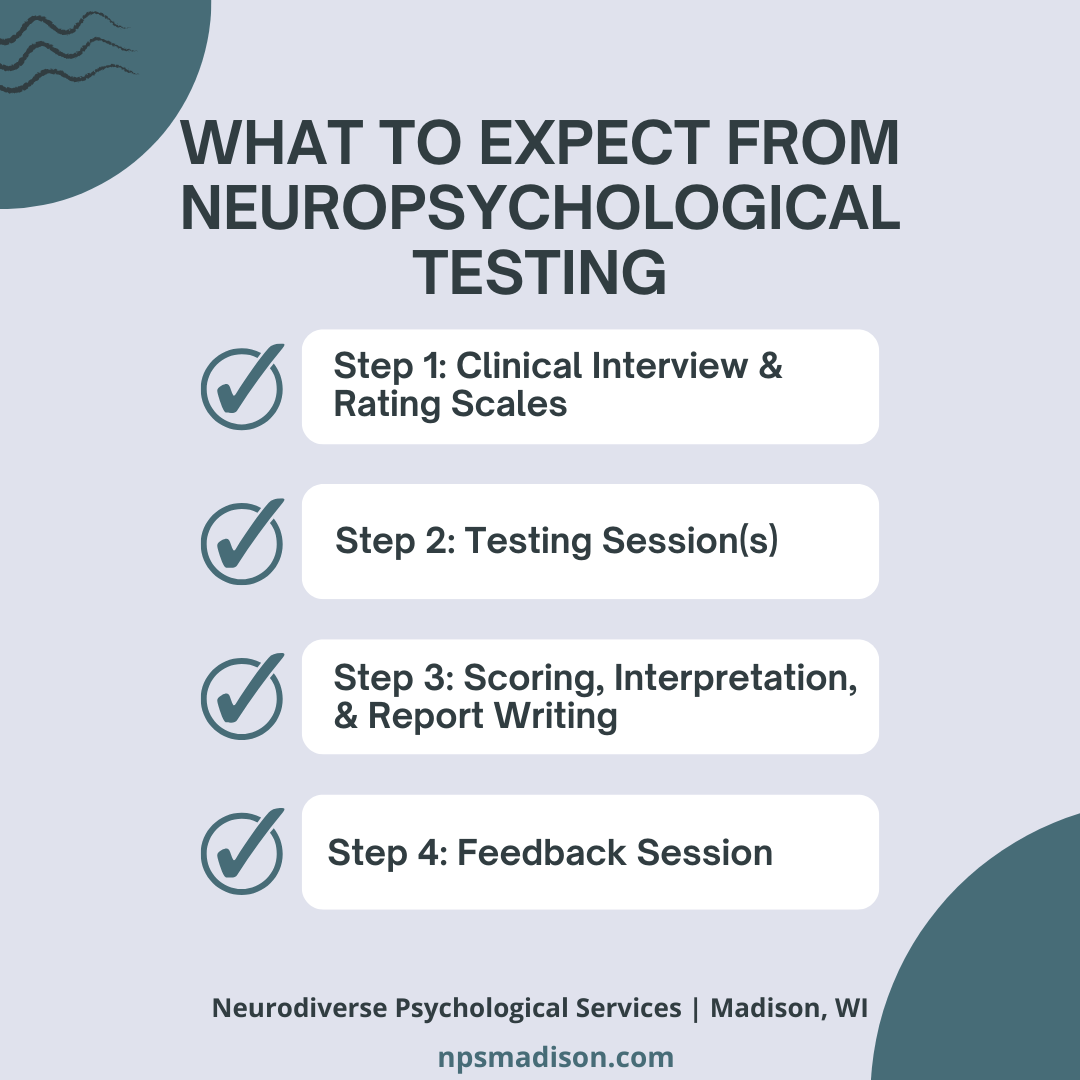
What to Expect From Neuropsychological Testing in Madison, WI
Step 1: Clinical Interview and Rating Scales
The first step in neuropsychological testing is a clinical interview with the child’s parent or guardian. This can be done via telehealth or in person at the office in Madison, WI. You will be asked questions about your child’s early development, medical history, skills, interests, behavior, your concerns, and your goals for the evaluation. The information gathered from this interview informs what neuropsychological testing will be included in the evaluation to address the referral questions. It also informs what diagnoses may be considered for the evaluation, as some diagnoses require that symptoms be present throughout the child’s development. Older children and teens may also participate in a clinical interview to get their perspective on how things are going and what concerns or questions they have about their functioning.
To prepare for a clinical interview, it can be helpful to review your child’s medical history and developmental milestones (e.g., think back to when they first started talking, walking, etc.). Looking through family videos or medical records might be helpful. You can also share any medical or educational records with the psychologist that might be important, such as prior diagnostic evaluations or special education records.
Around the time of the clinical interview, you will also likely be asked to complete some standardized rating scales about your child’s functioning in different areas. With your permission, your child’s teacher may also be asked to complete rating scales to offer information about how your child functions at school. Teacher rating scales can be an important source of information, as kids often present differently across home and school and some diagnoses require that symptoms be present across multiple settings. Standardized rating scales also offer a different type of information than what is provided during the clinical interview. Most of these instruments have scores that are calculated based on how your responses compare to other parents’ responses from large, national samples of same-age children. This gives the psychologist some information about how your child’s everyday functioning compares to other kids the same age.
Step 2: Testing Session(s)
Your child or teen will typically come for 1-2 testing sessions to participate in a variety of activities that measure skills in areas such as cognition/thinking, academics, language, attention, memory, social communication, and behavior. These sessions are in person at the office on the east side of Madison. Some of the activities might involve looking at pictures, answering questions, and completing puzzles. Depending on the age of your child, some assessments may also look at their play skills. If academics are a concern, testing might involve math, reading, and/or writing activities. You will likely be asked to wait in a separate room during the testing unless your child is very young or there is a clinical reason to have you participate, such as observing how your child responds to familiar adults. Breaks will be given and remember to bring water and snacks.
Step 3: Scoring, Interpretation, and Report Writing
This “behind-the-scenes” portion of the evaluation can sometimes be the most time-consuming part. The psychologist will score the assessments, integrate the results, and interpret them to form diagnostic impressions. They will then prepare a detailed written evaluation report that explains the results and any treatment or educational recommendations. These evaluation reports are often 10-15 pages in length depending on the complexity of the evaluation. The report serves as documentation of the evaluation results and may be needed in the future to access treatment or educational services.
Step 4: Feedback Session
Within a few weeks of the final testing session, you'll have a feedback session where the psychologist shares the results of the evaluation, their diagnostic impressions, and recommendations for treatment and/or educational services. There may be situations in which you will be given preliminary feedback sooner. Discuss with the psychologist in advance whether your child should attend this visit. During the feedback session, you will have the opportunity to ask questions. Make sure to ask any questions needed for you to understand the diagnosis and next steps. You will receive a copy of the written evaluation report at this visit or shortly afterward.
Considerations by Age
Preschool (Ages 2-5)

Early diagnosis can support access to early intervention, which has been shown to improve developmental outcomes for children with early delays.
For young children, evaluations often focus on cognitive development, language, social communication, adaptive skills, and behavioral regulation.
School-Age (Elementary and Middle)

Difficulties at school are often a reason that parents seek evaluations for their school-age children. As academic and social expectations increase, challenges with learning, attention, peer relationships, or emotion regulation may become more noticeable.
A comprehensive neuropsychological evaluation examines how a child’s cognitive abilities, executive functioning, academic skills, and behavior interact, providing clear, individualized recommendations to support learning, strengthen skills, and improve overall well-being in elementary and middle school.
Teens (High School)

High school brings greater expectations for independence, including managing busy schedules, long-term assignments, and planning for life after graduation. Executive functioning such as planning, organization, prioritizing, and time management become increasingly important. Some teens who compensated with strong cognitive or academic abilities throughout elementary and middle school may begin to struggle. Mental health conditions also tend to emerge during adolescence, and it is not always clear why a teen is struggling.
Neuropsychological testing in teens can help clarify diagnoses, provide detailed recommendations for any needed accommodations or services, and help guide families to support teens’ success in high school and the transition to adulthood.
College Students

College requires a high level of independence, with students managing rigorous coursework, employment, and adult responsibilities with far less structure than in high school. Long-standing learning, attention, or mental health challenges may become more impairing without prior supports or accommodations in place.
A neuropsychological evaluation for college students clarifies current functioning across cognitive, academic, executive, and emotional domains and determines whether functional impairments warrant academic accommodations. Results provide clear documentation and practical recommendations to support access to accommodations and success in higher education.
When Neuropsychological Testing May Not Be Necessary
A comprehensive evaluation is not necessary for every concern.
When there is a focused diagnostic question or difficulties are limited to a single area of functioning, another professional may be a more appropriate starting point:
An ADHD assessment for an elementary school-age child can often be completed by pediatrician or psychiatrist when there are no concerns about possible co-occuring neurodevelopmental conditions.
General concerns about a child’s reading skills can typically be assessed at school.
Anxiety or mood symptoms in teens that can be evaluated by a mental health therapist.
Comprehensive neuropsychological testing is most valuable when concerns span multiple domains, persist despite interventions, or require a detailed understanding of how areas of functioning interact.
Next Steps
Neuropsychological testing provides an integrated understanding of cognitive, academic, emotional, and behavioral functioning for children, teens, and college students. It is most useful when concerns are complex, persistent, or unclear, and when more information is needed for diagnosis, treatment planning, or educational decisions.
Parents do not need to have all the answers before seeking support. A brief consultation with a qualified professional can clarify whether a comprehensive evaluation is appropriate, whether updated testing is needed, or whether a more targeted approach would address the concerns.
Neurodiverse Psychological Services in Madison, WI offers a free 15-minute consultation to help families review their questions, understand what a comprehensive evaluation can provide, and identify the next steps toward accessing the right support for your child.